











He painted sea battles, the labours of Hercules and breathtaking still lifes. But, as a major new exhibition makes clear, it was in his thrilling depictions of the spiritual that the Spanish master showed his true genius
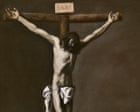
Against an impenetrable black ground, the crucified figure looms pale and shining. There’s almost no colour, beyond the trickle of blood on Christ’s feet from the nails driven through his flesh. His head slumps, and his carefully modelled face is at peace (no agony here). But the most striking part of the picture is surely the loincloth, which folds and crumples and bunches around his midriff – you can imagine passing your hand over it, feeling the linen’s volume and texture. In its original home, the monastery of San Pablo el Real in Seville, the painting was displayed with “little light”, according to the 17th-century Spanish artist and writer, Antonio Palomino. “Everyone who sees it, and does not know it, believes it to be a sculpture.” The paleness of the body, the fabric, must have loomed out of the dark like a vision.
Francisco de Zurbarán, who painted this solitary crucified Christ, is one of the three great artists of the Spanish 17th century. But, unlike his peers Velázquez and Murillo, he has never had a show to himself in the UK – until now, as his work forms the basis of a major exhibition about to open at the National Gallery in London. Compared with his precise contemporary and friend Velázquez (born in 1599, a year after Zurbarán), his work can seem stilled, becalmed. You can see the contrast clearly, in works commemorating Spanish military success that each of them were commissioned to paint for Philip IV of Spain’s new palace, the Palacio del Buen Retiro. Both are now in the Prado. Zurbarán’s The Defence of Cádiz Against the English has the quality of a frieze, as the Spanish generals look down serenely at the sea battle below. Velázquez’s The Surrender of Breda is all drama, encounter: a quicksilver painting that captures time as it flees.