











No more Kenyans to be enlisted by Moscow; Starmer warns against fossil fuel ‘windfall for Putin’ during war on Iran. What we know on day 1,483
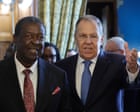
Russia has agreed to stop recruiting Kenyan citizens to fight with its army in Ukraine, Kenya’s foreign minister said on Monday after talks with his Russian counterpart in Moscow. More than 1,780 citizens from 36 African countries are believed to be fighting alongside Russia in Ukraine, according to Ukraine’s estimates in February. Kenya’s intelligence services estimate more than 1,000 Kenyans have been sent to fight, according to a report seen by Agence France-Presse (AFP). “We have now agreed that Kenyans shall not be enlisted,” the Kenyan foreign minister, Musalia Mudavadi, told reporters, sitting alongside the Russian foreign minister, Sergei Lavrov.
Since ordering troops into Ukraine in 2022, Russia has been widely accused of recruiting people from other nationalities to fight alongside its army. Lavrov said Kenyan citizens had voluntarily signed contracts to fight alongside the Russian army. Kenyan long-distance runner Evans Kibet – captured by Ukraine and held as a prisoner of war – told AFP in an interview from the facility where he was detained that he had been tricked into signing an army contract after going to Russia for a sporting event.
Keir Starmer, who will host Volodymyr Zelenskyy for talks on Tuesday, has warned the US-Israeli war on Iran cannot be allowed to become a “windfall for Putin”. Russia has received €6bn (£5bn) from selling its fossil fuels in the fortnight since the start of the war, data suggests. Zelenskyy’s visit will come on the day of the government deadline for the Russian oligarch Roman Abramovich to pay proceeds from his sale of Chelsea FC to victims of the Ukraine war, writes Jessica Elgot. Zelenskyy will visit Madrid on Wednesday for talks with Spain’s prime minister, Pedro Sánchez.
Belgium’s prime minister, Bart De Wever, has been criticised for calling for the normalisation of relations with Russia to re-establish cheap energy supplies, Jennifer Rankin reports. De Wever said Europe had to rearm “and at the same time we must normalise relations with Russia and regain access to cheap energy. It is common sense. In private European leaders tell me I am right, but no one dares say it out loud.”
Russia has taken control of 12 settlements in Ukraine in the first two weeks of March as part of advances along the frontline in eastern and southern Ukraine, according to Russian state-run news agencies, quoting top general Valery Gerasimov. Gerasimov said Russian forces were “actively moving towards Sloviansk,” a heavily defended town in eastern Ukraine’s Donetsk region long seen as one of Moscow’s major targets.
Russian air defence units downed at least 67 Ukrainian drones headed for Moscow on Monday, according to data published by the city’s mayor, Sergei Sobyanin. Sobyanin also said on Telegram that air defence units had shot down about 250 Ukrainian drones approaching Moscow over the previous two days.
Drone debris crashed on to the historic Maidan square in central Kyiv early on Monday during a rare daytime Russian attack on the Ukrainian capital, AFP journalists reported. The Ukrainian air force described the rush hour barrage as an “unusual” attack of “various types of strike drones”. It added that its air defence units had downed 194 Russian drones out of 211 launched overnight and into Monday. Three people were killed in the attacks overnight, officials said – one in the Zaporizhzhia region and two more in the Dnipropetrovsk region.
A damaged Russian gas tanker that has been drifting in the Mediterranean without a crew for almost two weeks has 700 tonnes of fuel on board, Russia’s foreign ministry said Monday. A series of explosions rocked the Arctic Metagaz on 3 March, causing serious damage to the vessel and forcing its crew to evacuate. Russia said the ship, sanctioned by the US and the EU for being part of Moscow’s “shadow fleet”, was attacked by Ukrainian sea drones. Ukraine has not commented.